MicroST: High-Precision Star Tracker for Microsatellite Missions
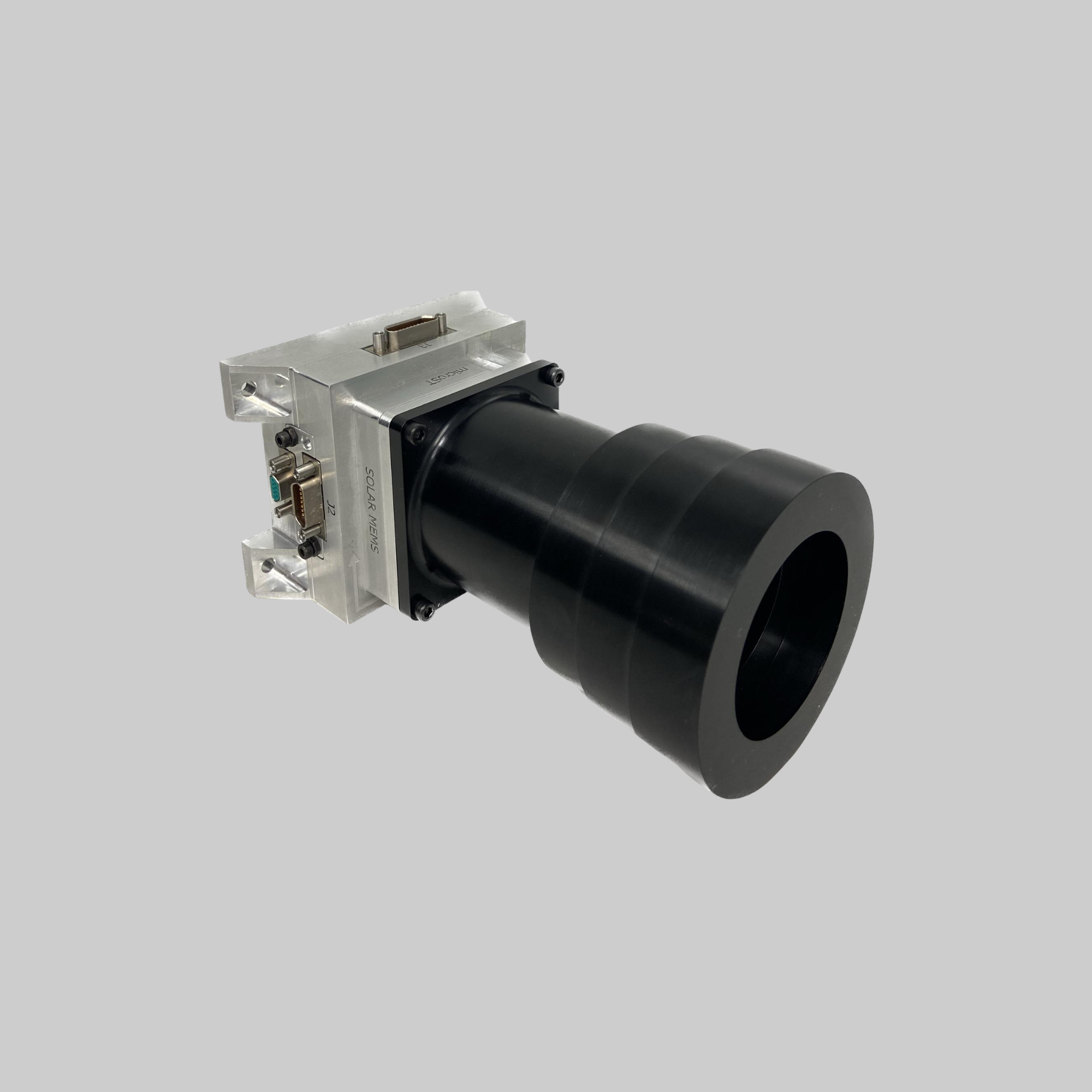
As satellite missions continue to increase in complexity and autonomy, the need for highly accurate and reliable attitude determination systems has become essential. To address these evolving mission requirements, Solar MEMS has developed the MicroST, a high-precision, cost-effective star tracker designed specifically for microsatellite platforms operating in Low Earth Orbit (LEO), with optional compatibility for MEO and GEO missions.
Combining advanced stellar navigation capabilities with a modular and robust architecture, the MicroST delivers precise spacecraft attitude determination while maintaining a compact and efficient form factor.
High-Accuracy Stellar Navigation
The MicroST uses an internal CMOS sensor to capture images of star fields and autonomously identify stars and constellations in real time. Through advanced onboard processing, the system calculates the precise orientation and pointing of the spacecraft with exceptional accuracy.
The standalone MicroST delivers:
- XY attitude accuracy (3σ): 6 arcsec
- Z attitude accuracy (3σ): 48 arcsec
- Acquisition time: less than 2 seconds
- Refresh rate: greater than 5 Hz (up to 10 Hz)
- Angular rate: less than 3.0 deg/sec
These capabilities make the MicroST an ideal solution for missions requiring precise attitude control, stable pointing performance, and autonomous spacecraft operations.
Designed for Space Reliability
The MicroST has been engineered using a combination of highly reliable Commercial Off-The-Shelf (COTS) components and selected space-grade parts, creating a robust yet cost-efficient architecture suitable for demanding space environments.
The system supports:
- Mission life: greater than 12 years in LEO
- TID hardness: >30 kRad
- Operating temperature: -35°C to 50°C
- Qualification temperature: -40°C to 70°C
Environmental robustness is further supported through rigorous vibration qualifications, including:
- Sine vibration: 20g @ 20–150 Hz
- Random vibration: 20 gRMS
- SRS: 1500 g @ 2000 Hz
Modular and Flexible Architecture
One of the key strengths of the MicroST is its modular design. While available by default as a standalone configuration, the system can also be configured as a star camera solution with separate optical heads upon request.
The architecture supports up to 2–3 camera heads through a dedicated controller unit, enabling enhanced performance and mission flexibility.
Optical Head Characteristics
- Volume: 60 x 60 x 110 mm
- Mass: <300 g
- Communication: SpaceWire
- Power: 5V, <2W
Controller Unit Characteristics
- Supports up to 2–3 optical heads
- Refresh rate: 10 Hz
- Communication: RS422
- Power: 5V, <6W
- Volume: 100 x 100 x 30 mm
- Mass: <500 g
Plug-and-Play Integration
The MicroST has been designed as a plug-and-play solution, simplifying spacecraft integration and reducing system complexity. The compact standalone unit requires minimal additional support electronics, helping satellite manufacturers reduce development timelines and optimize spacecraft resources.
The standalone MicroST communicates via RS422 and operates with low power consumption (<8W), making it highly suitable for modern microsatellite architectures.
Enabling the Future of Autonomous Spacecraft
As the space industry increasingly moves toward autonomous operations and resilient spacecraft systems, high-performance attitude determination solutions are becoming critical enabling technologies.
With its high accuracy, modular architecture, and robust space-qualified design, the MicroST demonstrates Solar MEMS’ commitment to delivering innovative stellar navigation solutions for the next generation of microsatellite missions.
Expected development milestones include:
- Expected TRL 8: July 2026
- Expected TRL 9: December 2026